Blog
January 06, 2026
Sustainability has become one of the most important global priorities in the 21st century. Rapid industrialization, urbanization, population growth, and excessive consumption have placed enormous pressure on the planet’s natural resources. Climate change, air and water pollution, overflowing landfills, and biodiversity loss clearly show that current lifestyles are not environmentally sustainable.
To address these challenges, individuals, communities, and businesses must adopt responsible consumption and waste-management practices. One of the most effective and widely accepted frameworks for eco-friendly living is the 7 R’s of Sustainability. This approach focuses on reducing waste, conserving resources, and promoting long-term environmental balance through simple, everyday actions.
🌍 What Are the 7 R’s of Sustainability?
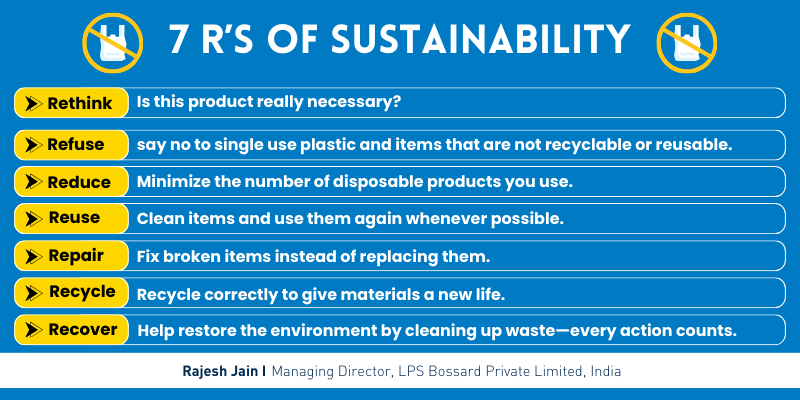
The 7 R’s of Sustainability include Rethink, Refuse, Reduce, Reuse, Repair, Recycle, and Recover. These principles follow a clear hierarchy that emphasizes waste prevention before waste treatment. Instead of the traditional “take, make, and dispose” model, the 7 R’s promote a circular economy where resources remain in use for as long as possible.
By adopting these sustainability principles, people can reduce their carbon footprint, save money, and contribute to environmental protection without compromising comfort or convenience.
🤔 Rethink: Building Awareness and Conscious Consumption
Rethinking is the foundation of sustainable living. It involves questioning daily habits and consumption patterns before making decisions. Many environmental problems begin with unnecessary consumption, impulse buying, and lack of awareness about environmental impact.
Rethinking encourages choices such as selecting durable products over cheap disposable ones, choosing energy-efficient appliances, and planning purchases carefully. Using public transport, carpooling, or walking short distances instead of driving alone are also examples of rethinking everyday choices. When people consciously rethink their actions, they reduce waste generation and conserve natural resources.
🚫 Refuse: Preventing Waste at the Source
Refusing means avoiding products that are unnecessary, harmful, or environmentally damaging. This step is especially important in combating plastic pollution and excessive packaging. Single-use plastics, disposable cups, plastic straws, and low-quality promotional items contribute significantly to waste problems.
Refusing free plastic bags, disposable cutlery, and over-packaged products helps reduce waste before it enters the system. This practice also encourages manufacturers to adopt sustainable materials and eco-friendly packaging solutions.
📉 Reduce: Minimizing Resource Use and Waste Generation
Reducing focuses on using fewer resources while maintaining quality of life. It applies to energy, water, food, and material consumption. Small lifestyle changes such as switching off unused lights, using energy-efficient bulbs, reducing water wastage, and buying only what is needed can make a significant difference.
Reducing food waste by planning meals, storing food properly, and avoiding over-buying also plays a crucial role in sustainability. Lower consumption leads to reduced greenhouse gas emissions, lower pollution levels, and long-term cost savings.
🔁 Reuse: Extending the Life Cycle of Products
Reusing involves using items repeatedly instead of discarding them after one use. Many everyday items can be reused in creative and practical ways. Glass containers can be used for storage, old clothes can serve as cleaning cloths, and reusable bottles and lunch boxes can replace disposable alternatives.
By reusing products, demand for new materials decreases, which saves energy and raw resources used in manufacturing. Reuse also helps reduce landfill waste and supports a more sustainable consumption cycle.
🛠️ Repair: Moving Away from the Throwaway Culture
Repairing promotes fixing broken or damaged items instead of replacing them. In modern consumer culture, many products are discarded at the first sign of damage, even when repair is possible. Repairing clothes, electronics, furniture, and appliances helps extend their lifespan.
This practice reduces waste, conserves resources, and saves money. Repair culture also supports local artisans and service providers, contributing to sustainable economic growth.
♻️ Recycle: Converting Waste into Valuable Resources
Recycling is the process of converting waste materials into new products. Paper, glass, metal, and certain plastics can be recycled when waste is properly segregated. Recycling reduces the need for virgin raw materials, conserves energy, and decreases pollution.
While recycling is an important part of sustainability, it is most effective when combined with refusing, reducing, reusing, and repairing. Proper recycling practices help manage waste responsibly and support environmental conservation.
🔄 Recover: Extracting Value from Remaining Waste
Recovering refers to extracting useful materials or energy from waste that cannot be reused or recycled. Organic waste can be composted to produce nutrient-rich fertilizer, while waste-to-energy systems can generate power from non-recyclable waste.
Recovery ensures that minimal waste ends up in landfills and helps close the loop in sustainable waste management. It plays a vital role in achieving long-term sustainability goals.
🌱 Importance of the 7 R’s in Sustainable Development
The 7 R’s of Sustainability contribute significantly to environmental protection, economic stability, and social well-being. They help reduce pollution, conserve natural resources, lower carbon emissions, and promote responsible production and consumption.
Adopting these principles at individual and community levels leads to healthier living conditions, reduced environmental risks, and improved quality of life.
🌎 Role of Individuals, Communities, and Businesses
Sustainability is a shared responsibility. Individuals can adopt eco-friendly habits at home, communities can promote waste segregation and composting, and businesses can design sustainable products and packaging. Educational institutions and workplaces can spread awareness and encourage environmentally responsible behavior.
Government support and corporate participation further strengthen sustainability efforts and accelerate the transition to a greener economy.
🌍 A Sustainable Future Starts Today
The 7 R’s of Sustainability provide a practical and effective roadmap for sustainable living. By rethinking choices, refusing unnecessary items, reducing consumption, reusing products, repairing what is broken, recycling responsibly, and recovering value from waste, everyone can contribute to environmental protection.
Sustainability is not about drastic change—it is about making better choices every day. When practiced consistently, these small actions create a powerful impact, leading to a cleaner, healthier, and more sustainable future for generations to come.
Share :
Recent Post
-

🚭 What Happens to Your Body When You Quit Tobacco?
September 18, 2026 -

♻️ E-Waste: Why It Matters More Than Ever
June 30, 2026 -

☀️ Top 10 Benefits of Switching to Solar Energy Today
June 17, 2026 -

⚡ Electric Mobility: Driving Toward a Cleaner Tomorrow
June 17, 2026 -

🌿 Eco-Friendly Habits for Everyday Life
June 17, 2026 -

💧 Saving Water, Saving Life : A Call for Action
March 30, 2026 -

♻️ Waste Segregation: A Simple Step Toward Clean Living
January 31, 2026 -

☀️ Why Solar Energy Is the Key to a Sustainable Future
December 27, 2025 -

🌳 How Forests Help Fight Climate Change
December 24, 2025 -

🌍 What Is Climate Change?
November 29, 2025 -

Bhagwan Mahavir: A Visionary of Truth, Simplicity, and Self-Discipline
September 27, 2025 -

🌍 9 Ways to Reduce Your Carbon Footprint
August 18, 2025 -

High-Oxygen Trees for Sustainable Living
July 26, 2025 -

5S at LPS Bossard India: Small Steps, Big Impact
July 09, 2025 -

Say No to Tobacco: A Path to a Healthier Life
April 01, 2025 -

Stop War, Spread Love - Together for Peace!
January 02, 2025 -

Say No to Plastic: A Step Towards a Greener Future
October 06, 2024


Copyright © 2024 Rajesh Jain | All Rights Reserved.
